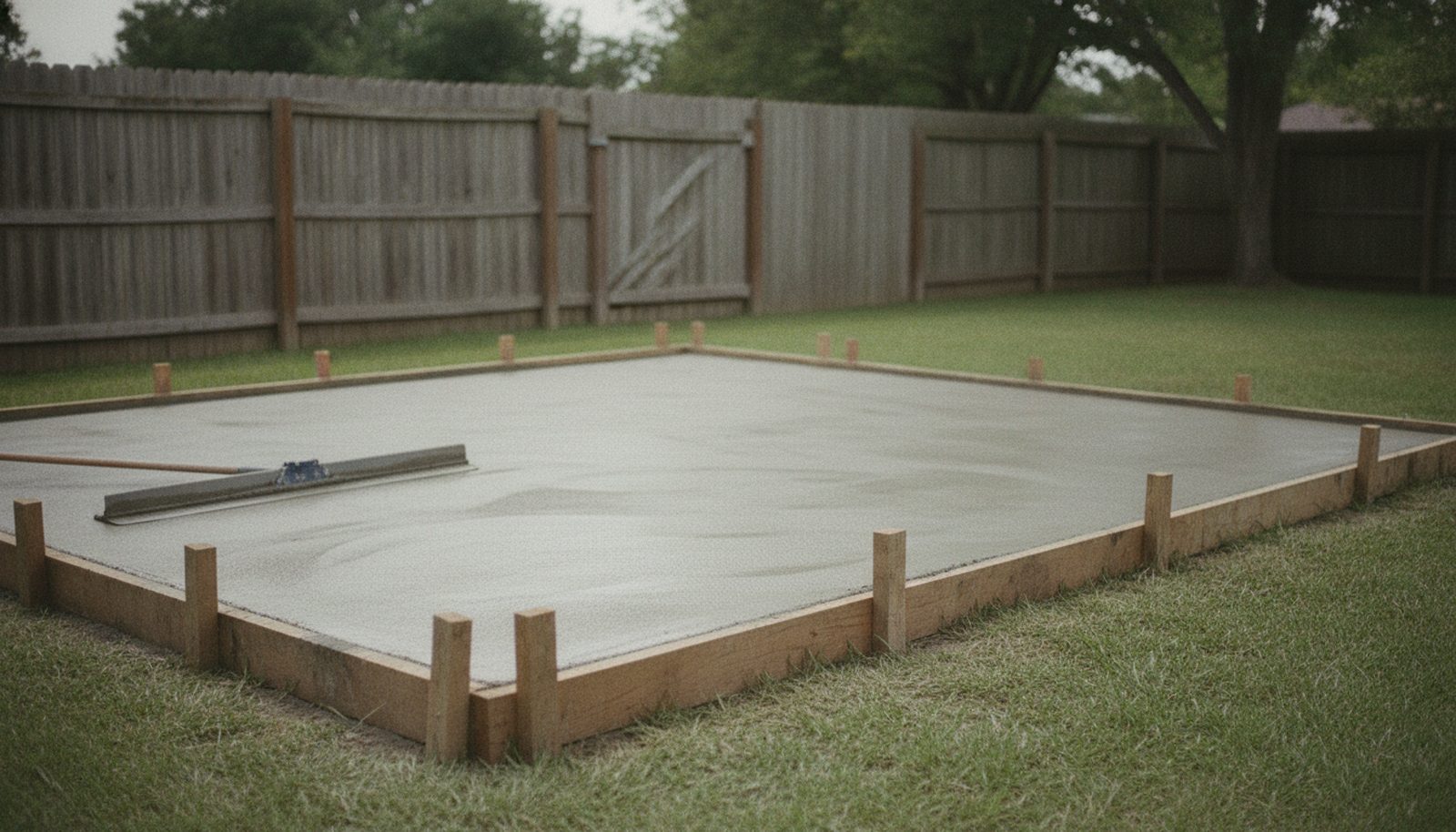
Concrete Slab Calculator
Volume = area × thickness; cubic yards = cubic feet ÷ 27. Bag yields are the manufacturers’ (Quikrete, Sakrete): 80 lb → 0.60 cu ft, 60 lb → 0.45, 50 lb → 0.375, 40 lb → 0.30. The ready-mix order adds your waste allowance and rounds up to the quarter yard; the short-load fee applies under 4 yd. Prices are your inputs — check a local supplier; 2026 ready-mix runs about $140–$190 per yard delivered.
Type the slab size and thickness — a 10 × 10 slab at 4 in is 1.23 cubic yards or 56 eighty-pound bags — and get cubic yards, bags in every size, the ready-mix order rounded to the quarter yard, and whether bags or a truck is cheaper. Footings, sonotube post holes and steps too.
Enter the slab in feet and the thickness in inches; the calculator multiplies them for cubic feet, divides by 27 for cubic yards, then converts to bags using each bag size’s real yield and to a ready-mix order rounded up to the quarter yard. Switch to Footing for a trench (width × depth in inches, length in feet), Post holes for sonotubes or dug piers (the post’s own volume is subtracted), or Steps for solid poured stairs. The verdict weighs bags against a truck on both price and the practical limit of hand mixing.
How much concrete do I need for a 10×10 slab?
A 10 × 10 ft slab 4 inches thick needs 1.23 cubic yards of concrete (33.3 cubic feet), which is 56 eighty-pound bags, 75 sixty-pound bags, or a 1.5-yard ready-mix order once you add 5% for waste and round to the quarter yard. At 6 inches the same slab needs 1.85 cubic yards or 84 eighty-pound bags. The formula: width × length × (thickness ÷ 12) = cubic feet; ÷ 27 = cubic yards.
The concrete formula, worked
- 10 ft × 10 ft = 100 sq ft of slab.
- 4 in ÷ 12 = 0.333 ft thick.
- 100 × 0.333 = 33.3 cubic feet.
- 33.3 ÷ 27 = 1.23 cubic yards.
- Bags: 33.3 ÷ 0.60 cu ft per 80-lb bag = 55.6 → 56 bags (4,480 lb of mix). With 5% waste, 59.
- Truck: 1.23 × 1.05 = 1.30 yd → order 1.5 yd (suppliers sell in quarter yards).
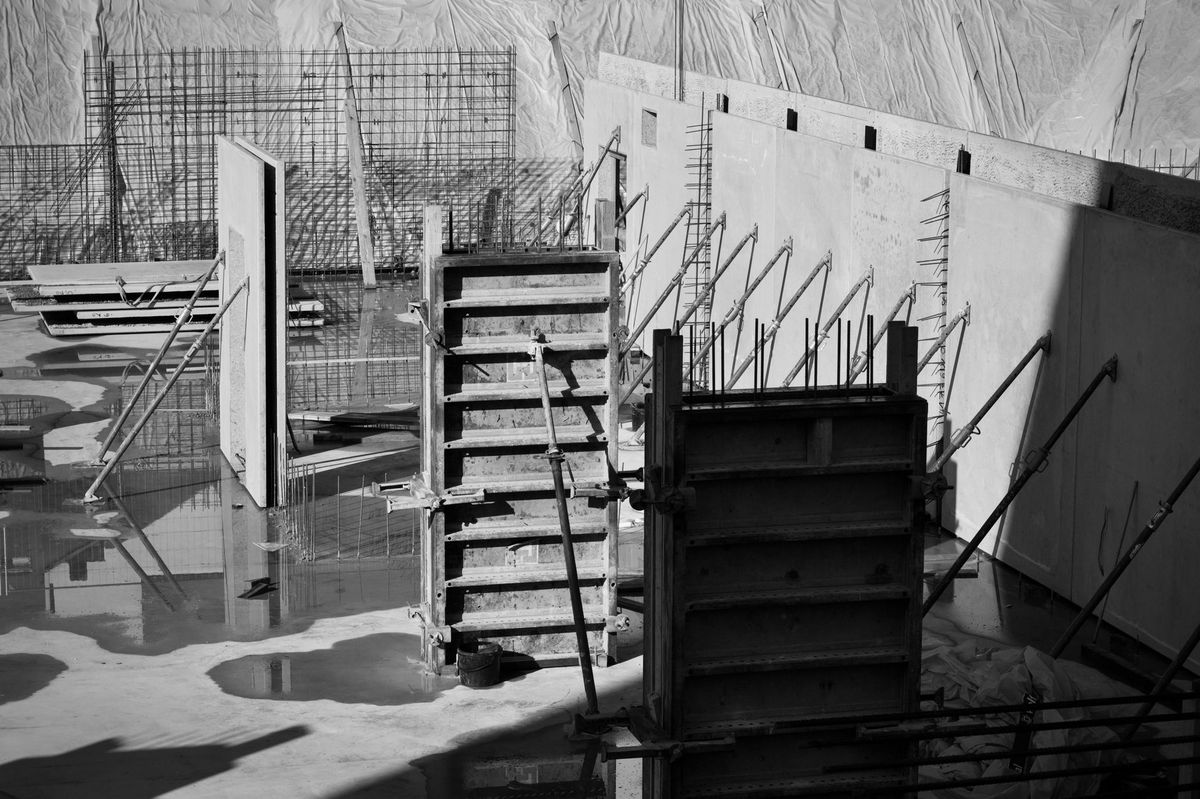
The common mistake is mixing units: a thickness typed as 4 ft instead of 4 in gives twelve times the concrete. The second is forgetting that forms are never perfectly level; the ground under a “4-inch” slab usually averages 4½ in, which is where the 5–10% waste allowance goes.
| Slab | 4 in: cu yd | 80-lb bags | 60-lb bags | Ready-mix | 6 in: cu yd | 80-lb bags | Ready-mix |
|---|---|---|---|---|---|---|---|
| 8 × 8 ft (64 sq ft) | 0.79 | 38 | 50 | $260 | 1.19 | 56 | $300 |
| 8 × 10 ft (80 sq ft) | 0.99 | 47 | 63 | $300 | 1.48 | 70 | $380 |
| 10 × 10 ft (100 sq ft) | 1.23 | 59 | 78 | $340 | 1.85 | 88 | $420 |
| 10 × 12 ft (120 sq ft) | 1.48 | 70 | 94 | $380 | 2.22 | 105 | $500 |
| 12 × 12 ft (144 sq ft) | 1.78 | 84 | 112 | $420 | 2.67 | 126 | $580 |
| 12 × 16 ft (192 sq ft) | 2.37 | 112 | 150 | $500 | 3.56 | 168 | $700 |
| 12 × 20 ft (240 sq ft) | 2.96 | 140 | 187 | $620 | 4.44 | 210 | $760 |
| 16 × 20 ft (320 sq ft) | 3.95 | 187 | 249 | $680 | 5.93 | 280 | $1,000 |
| 20 × 20 ft (400 sq ft) | 4.94 | 234 | 312 | $840 | 7.41 | 350 | $1,280 |
| 20 × 24 ft (480 sq ft) | 5.93 | 280 | 374 | $1,000 | 8.89 | 420 | $1,520 |
| 24 × 24 ft (576 sq ft) | 7.11 | 336 | 448 | $1,200 | 10.67 | 504 | $1,800 |
| 24 × 30 ft (720 sq ft) | 8.89 | 420 | 560 | $1,520 | 13.33 | 630 | $2,240 |
| 30 × 40 ft (1,200 sq ft) | 14.81 | 700 | 934 | $2,520 | 22.22 | 1,050 | $3,760 |
Bag counts include 5% waste and use 0.60 cu ft (80 lb) and 0.45 cu ft (60 lb) yields. Ready-mix = order rounded up to ¼ yd × $160, plus a $100 short-load fee under 4 yd; concrete only, no pumping or labor.
Read the table against your truck: a 12 × 12 slab is 1.78 yards, which is 84 eighty-pound bags — 6,700 lb of mix, three pickup loads at the rated payload, and about four hours of continuous mixing. That is the point where ready-mix stops being a luxury. Anything 10 × 12 and up, call for a quote; anything 8 × 8 and under is a weekend with bags.
How many bags of concrete per cubic yard? Bag yields by size
A cubic yard is 27 cubic feet, and an 80-lb bag of concrete mix makes 0.60 cubic feet, so it takes 45 eighty-pound bags to make one cubic yard. Sixty-pound bags yield 0.45 cu ft (60 per yard), 50-lb bags 0.375 cu ft (72 per yard) and 40-lb bags 0.30 cu ft (90 per yard). The yield is printed on the bag; Quikrete and Sakrete standard mixes agree to within a rounding error. Fast-setting mix yields slightly less (an 80-lb bag of Quikrete Fast-Setting makes about 0.52 cu ft), so for post holes in fast-set add 15%.
| Bag | Yield | Bags per cu yd | Bags per 10×10×4 slab | Water per bag | Typical price (2026) |
|---|---|---|---|---|---|
| 80-lb bag | 0.60 cu ft | 45 | 56 | 3 qt | $6–8 |
| 60-lb bag | 0.45 cu ft | 60 | 75 | 2.25 qt | $5–7 |
| 50-lb bag | 0.375 cu ft | 72 | 89 | 1.9 qt | $4.50–6 |
| 40-lb bag | 0.30 cu ft | 90 | 112 | 1.5 qt | $4–5.50 |
Yields from manufacturer data (Quikrete 1101, Sakrete High Strength). Water is for a workable mix; too much water weakens concrete more than anything else you can do. Prices are big-box shelf prices and vary by region.
Price per cubic foot favors the big bag: at $6.50 an 80-lb bag is $10.80 per cubic foot, at $5.50 a 60-lb bag is $12.20. Bagged concrete therefore costs roughly $290–$330 per cubic yard before tax, against $140–$190 per yard for ready-mix delivered — the truck wins on price from the first yard, and the short-load fee is what keeps bags competitive under about a yard. Mixing rate is the other limit: one person with a wheelbarrow does an 80-lb bag every 5–6 minutes, a small electric mixer two at a time every 4 minutes. A 56-bag slab is four to five hours of mixing, during which the first wheelbarrows are already setting.
How thick should a concrete slab be?
Four inches is the standard for patios, sidewalks, shed floors and residential garage floors; five to six inches for driveways that will see trucks, RVs or a car lift; six inches for workshop floors with heavy equipment. The International Residential Code sets 3½ in as the minimum for a slab on grade (R506.1) and requires a 4-in base of gravel, crushed stone or sand under it, with a vapor retarder under any slab inside the house. Footings start at 6 in thick and 12 in wide (R403.1) and go below the local frost line, which ranges from zero in Florida to 48 in or more in Minnesota.
| Project | Thickness | Mix strength | Reinforcement and joints | Base |
|---|---|---|---|---|
| Sidewalk, walkway | 4 in | 3,000–3,500 psi | Mesh optional; control joints every 4–5 ft | 4 in gravel |
| Patio, pool deck | 4 in | 3,500 psi | Wire mesh or fiber mix; joints every 8–10 ft | 4 in gravel |
| Shed or hot-tub pad | 4 in (6 in under a filled hot tub) | 3,500–4,000 psi | Mesh; #3 rebar for a hot tub | 4 in gravel |
| Driveway, cars only | 4–5 in | 4,000 psi, air-entrained in freeze climates | #3 rebar on 18-in grid or 6×6 mesh; joints every 10–12 ft | 4–6 in gravel |
| Driveway, trucks / RV | 6 in | 4,000–4,500 psi | #4 rebar on 12–16 in grid | 6 in gravel |
| Garage floor | 4 in (6 in for heavy trucks or a lift) | 3,500–4,000 psi | #3 rebar or mesh; slope ⅛ in/ft to the door | 4 in gravel + vapor barrier |
| Footing (IRC R403) | 6 in minimum thick, 12 in wide; 8–12 in typical | 2,500–3,000 psi | Two #4 bars continuous | Undisturbed soil below frost line |
| Deck or fence post pier | 8–12 in diameter × 36–48 in deep | 3,000 psi (bagged mix) | None; post base bracket | 6 in gravel at the bottom |
IRC 2021 R403 (footings), R506 (slabs), Table R402.2 (minimum compressive strength by exposure). Local codes and soil reports override these; expansive clay soils often need a post-tensioned or thicker slab.
Thickness is the cheapest upgrade you can buy. Going from 4 in to 5 in on a 20 × 24 driveway adds 1.5 yards — about $250 of concrete — and raises the slab’s load capacity by roughly 50%, since a slab’s bending strength rises with the square of its thickness. Rebar and mesh do not make a slab stronger in the sense people expect; they hold the cracks together once it cracks. Control joints, cut to a quarter of the slab depth at spacings of 2–3 times the thickness in feet, decide where the cracks go.
Bags or a ready-mix truck: where the line is
The line is about one cubic yard — 45 eighty-pound bags. Below it, bags are cheaper once you count the short-load fee, and the mixing is a morning’s work. Above it, a truck is cheaper per yard, pours in twenty minutes, and gives you one monolithic slab instead of a patchwork of batches that set at different times (a “cold joint” between batches is a crack waiting to happen). Between one and two yards you can argue either way; above two yards, nobody who has mixed 90 bags argues.
Ready-mix: how ordering works
- Minimum and fees: most plants charge a short-load fee of $60–$150 for orders under 4–5 yards and a delivery fee per truck; some have a 1-yard minimum. Trucks carry 8–10 yards.
- Price: $140–$190 per yard delivered in most U.S. markets in 2026 for a 3,500–4,000 psi mix, more for fiber, air entrainment or hot-weather retarders. Quotes are per yard; order in quarter-yard steps and add 5–10%.
- Time on site: typically 5–8 minutes per yard free, then $1–$2 per minute, so have the wheelbarrows, screed and three people ready before the truck arrives.
- Access: a loaded truck weighs 60,000+ lb and will crack an old driveway or sink in soft lawn; a pump truck adds $600–$1,000 if the chute cannot reach.
Bags: how to do it well
- Rent a mixer for anything over 20 bags; two people, one feeding, one placing.
- Use the water on the bag (about 3 quarts for an 80-lb bag) — a soupy mix is easier to place and loses a third of its strength.
- Pour in strips the width of the slab so each batch joins wet concrete, not set concrete.
- Buy 10% extra; unopened bags return.
Footings, post holes and steps
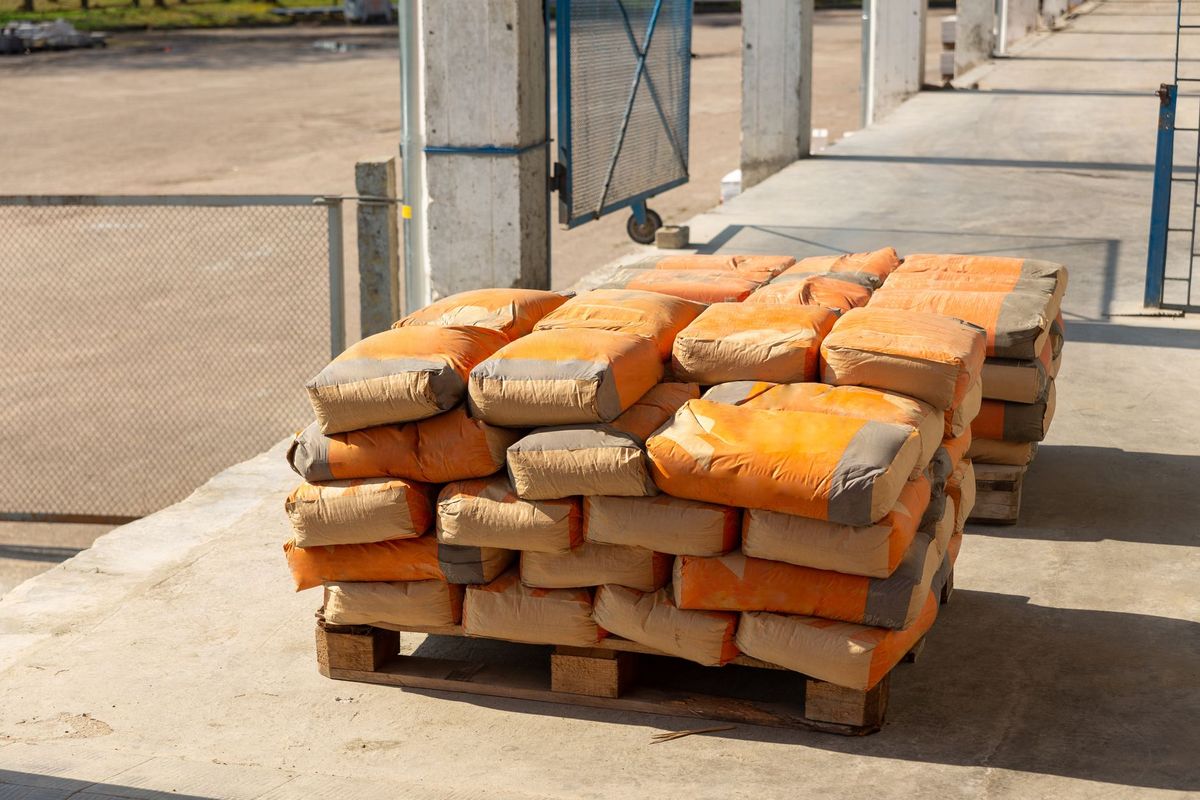
Footings are long and thin, so the volume is width × depth (both in inches, each ÷ 12) × length in feet. A 16 × 8 in footing 40 ft long is 1.33 ft × 0.67 ft × 40 = 35.6 cu ft = 1.32 yards. The IRC minimum under a one-storey wood-frame wall on average soil is 12 in wide and 6 in thick, with the bottom below the frost line, so in northern states a footing trench is often 8 in thick at 42–48 in deep and the volume is dominated by the stem wall or the backfill.
Post holes are cylinders: π × (diameter ÷ 2)² × depth, in inches, ÷ 1,728 for cubic feet. A 12-in sonotube 36 in deep holds 2.36 cu ft, and six of them 14.1 cu ft — 0.52 yards, 25 eighty-pound bags with waste. If a 4×4 post is set directly in the hole, its 3.5 × 3.5 in section takes 0.26 cu ft out of each; the calculator subtracts it. Deck piers for a ledger-free deck are usually 10–12 in diameter; fence posts 8–10 in; a hot-tub or pergola post 12 in. Dig 6 in deeper than the concrete and put gravel at the bottom so water drains.
Steps poured solid are a stack of blocks: each step’s block is width × run × (rise × its number from the top). Three steps 4 ft wide with 7-in rises and 11-in runs are 12.8 cu ft, 0.48 yards, 23 eighty-pound bags. Most contractors form the steps hollow over compacted fill or rubble when there are more than four, which cuts the concrete by half or more; the calculator assumes solid. Rise and run must satisfy the stair code (7¾ in maximum rise, 10 in minimum tread) — the stair calculator works out the rise and run for a given height.
| Slab thickness | Joint spacing | Joint depth |
|---|---|---|
| 4 in | 8–10 ft | 1 in (¼ of thickness) |
| 5 in | 10–12 ft | 1¼ in |
| 6 in | 12–15 ft | 1½ in |
Rule of thumb: spacing in feet = 2 to 3 × thickness in inches; cut within 6–18 hours of finishing, before the slab cracks on its own. Keep panels close to square (length no more than 1.5 × width).
How much does a concrete slab cost?
Installed, a plain 4-in slab on grade costs about $6–$12 per square foot in 2026 — concrete, gravel base, forms, mesh, placing and a broom finish — so a 10 × 10 slab is $600–$1,200, a 10 × 12 is $720–$1,440 and a 24 × 24 garage floor $3,500–$7,000. Thickened edges, rebar grids, a 6-in slab, a vapor barrier, stamped or polished finishes and bad access push the range to $12–$20 per square foot. Materials alone run about $3–$4.50 per square foot at 4 in (close to $2 of it is the concrete at $160 a yard; the rest is gravel, forms, mesh and sealer), so labor is half to two-thirds of a contractor’s price.
Doing it yourself, the 10 × 10 slab above is roughly $380 in bags or $340 for a short-load truck, plus $60–$100 of gravel, $40 of form lumber, $50 of mesh and a $60 mixer rental — about $550–$650 and a long day for two people. The saving against a contractor is real but the risk is in the finish: screeding and floating a slab is a skill, and a wavy shed floor is forever. For a garage floor (size it here) or anything with a building on top, get it done; for a hot-tub pad, a walkway or a small patio, pour it. Estimate the gravel under the slab, and the fill around it, with the gravel calculator; for a whole-house foundation and slab, see the cost to build calculator.
How this concrete slab calculator works and where the numbers come from
Slab volume = width × length × thickness ÷ 12 (cubic feet), footing = width ÷ 12 × depth ÷ 12 × length, post holes = π × (diameter ÷ 2)² × depth ÷ 1,728 minus the post section × depth, steps = width × run × rise × (1 + 2 + … + n) ÷ 1,728. Cubic yards = cubic feet ÷ 27. Bags = cubic feet × (1 + waste) ÷ yield, rounded up, with yields of 0.60, 0.45, 0.375 and 0.30 cu ft for 80, 60, 50 and 40-lb bags. The ready-mix order is cubic yards × (1 + waste) rounded up to ¼ yd; cost = order × price per yard plus the short-load fee under 4 yd. Mesh = slab area × 1.1; rebar = #3 bars on an 18-in grid; gravel = area × 4 in × 1.2 for compaction. Cost ranges in the article are industry figures, not quotes.
- Quikrete Concrete Mix (No. 1101) and Fast-Setting Concrete product data: yield per bag and water
- International Residential Code 2021: R403 footings, R506 concrete floors on ground, Table R402.2 concrete strength
- American Concrete Institute ACI 332 (residential concrete) — joint spacing and slab practice
- Ready-mix and installed slab prices: contractor cost guides and supplier quotes, 2025–26 — ranges, not a survey; get a local quote
Last reviewed November 6, 2026. Estimates only — verify local figures before you commit money.
Concrete Slab Calculator: FAQ
How many bags of concrete do I need for a 10×10 slab? +
56 eighty-pound bags (or 75 sixty-pound bags) for a 10 × 10 slab 4 inches thick, which is 33.3 cubic feet or 1.23 cubic yards. Buy 59–62 bags to allow 5–10% for an uneven base. At 6 inches thick it takes 84 eighty-pound bags.
How many 80-lb bags of concrete make a yard? +
45. An 80-lb bag yields 0.60 cubic feet and a cubic yard is 27 cubic feet, so 27 ÷ 0.6 = 45 bags (3,600 lb of dry mix). It takes 60 sixty-pound bags, 72 fifty-pound bags or 90 forty-pound bags to make the same yard.
What is the formula for calculating concrete? +
Width × length × thickness, all in feet, gives cubic feet; divide by 27 for cubic yards. Convert the thickness from inches first (4 in = 0.333 ft). For a round hole use π × radius² × depth. Add 5–10% for waste and round a ready-mix order up to the quarter yard.
How much does a 10×10 concrete slab cost? +
About $600–$1,200 installed for a plain 4-in slab ($6–$12 per square foot), or $550–$650 in materials if you pour it yourself: 59 bags of mix at about $380, plus gravel, forms, mesh and a mixer rental. A 10 × 12 slab costs $720–$1,440 installed.
How thick should a concrete slab be? +
4 inches for patios, sidewalks, sheds and garage floors; 5–6 inches for driveways carrying trucks or RVs and for workshop floors with heavy equipment. The IRC minimum is 3½ inches over a 4-inch gravel base. Footings are at least 6 inches thick and 12 inches wide.
When should I order a ready-mix truck instead of bags? +
Above about one cubic yard (45 eighty-pound bags). A truck is cheaper per yard even with a $60–$150 short-load fee, pours in minutes, and makes one continuous slab; mixing 45+ bags takes four hours and leaves cold joints. Under half a yard no truck will come, so bags are the only option.
How much concrete for a sonotube post hole? +
A 12-in-diameter hole 36 in deep holds 2.36 cubic feet — four 80-lb bags, or 3.5 bags if a 4×4 post is set in it. An 8-in hole at 36 in holds 1.05 cu ft (two bags); a 10-in hole 1.64 cu ft (three bags). Add 6 in of gravel below the concrete for drainage.
How much is a yard of concrete in 2026? +
About $140–$190 per cubic yard delivered for a standard 3,500–4,000 psi mix, plus a short-load fee of $60–$150 on orders under 4–5 yards. Bagged mix works out to roughly $290–$330 per yard, which is why a truck wins on price for anything over a yard.
Related tools and data
Mulch, Soil & Gravel Calculator
Cubic yards, bags and weight for the gravel base and backfill.
Garage Size Calculator
Size the garage before you pour its floor.
Cost to Build Calculator
Foundation, slab and the rest of the house by state.
Stair Calculator
Rise, run and stringers for steps that meet code.
Deck Builder
Plan the deck whose piers you are pouring.
Fence Builder
Post count and spacing for the fence line.